NEWS AND BLOGS
SEAN SUTCLIFFE'S ARTICLE IN THE SKY AT NIGHT MAGAZINE
Our CEO Sean Sutcliffe wrote an article for the BBC Sky at Night magazine June edition, this is an edited version:
The proliferation of mega-constellations of satellites has attracted plenty of concern, whether from the fear of a chain reaction resulting in catastrophic levels of space debris or the effect on astronomy from light pollution. While these are very real problems, the increasing use of low earth orbit satellites has also brought a range of benefits, and at Oxford Space Systems we aim to contribute towards those.
The dilemma facing mission designers is that in order to get the performance they want they need as large an antenna as possible to get the gain or resolution required. However that takes up too much space and weighs too much. The solutions that Oxford Space Systems provide are deployable antennas, which as well as saving space are also lower mass. As an example the OSS Yagi antenna when stowed fits in a box that is about 10cm cubed. Then when it deploys on a satellite in orbit the antenna has a length of 60cm and a span of 90cm. The first satellite that will use this antenna to monitor shipping is due to launch later this year. We have three other helical antennas in space, launched in the last year, enabling Internet of Things connectivity at low cost, helping to improve among other things logistics, wildlife monitoring and agriculture. We have also launched a deployable boom as part of a mission to test debris removal, making a contribution in the search for solutions to this looming problem.
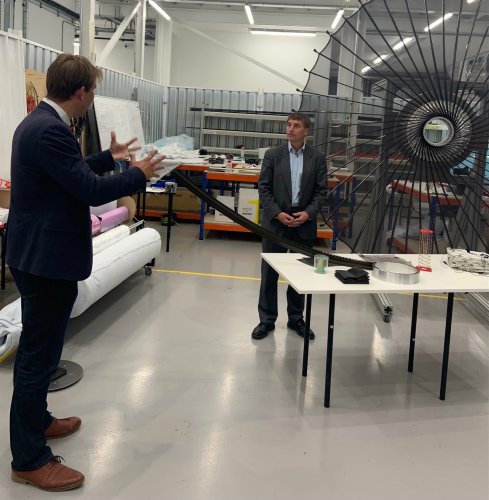
Alongside these immediately practical applications we also contribute to the broader UK space strategy. A recent project we have looked at addresses a future international mission to map ice on Mars. For this we can take a wrapped rib deployable antenna we are developing to provide synthetic aperture radar for earth observation and determine what it would take to adapt it for a Mars mission. The same benefits of radar that allow day/night and through-cloud monitoring of floods on Earth can also extend our knowledge further afield.
Apart from the obvious lure of being involved in space exploration, why are the people at Oxford Space Systems so passionate about what they do?
I think on the one hand it is due to the sheer difficulty of the job in hand. The need for equipment to survive the harsh conditions of a launch and space environment whilst guaranteeing successful deployment of what looks on the face as if it is a very intricate and lightweight antenna is a terrific engineering challenge – and we all like to succeed in the face of a tough task. The other aspect is the thrill of doing something new. The teams are bringing new ideas to space, whether it is use of composites for backing structure ribs, origami engineering to create compact structures, or metal mesh knitting technology to provide high performance antenna surfaces. This requires a blend of openness to new ideas, working in diverse interdisciplinary teams and a dedication to ensuring the product is absolutely right. This level of enthusiasm, whether it is displayed in the office or on a Zoom call means that for me it is an honour and a pleasure to be part of the Oxford Space Systems story.